
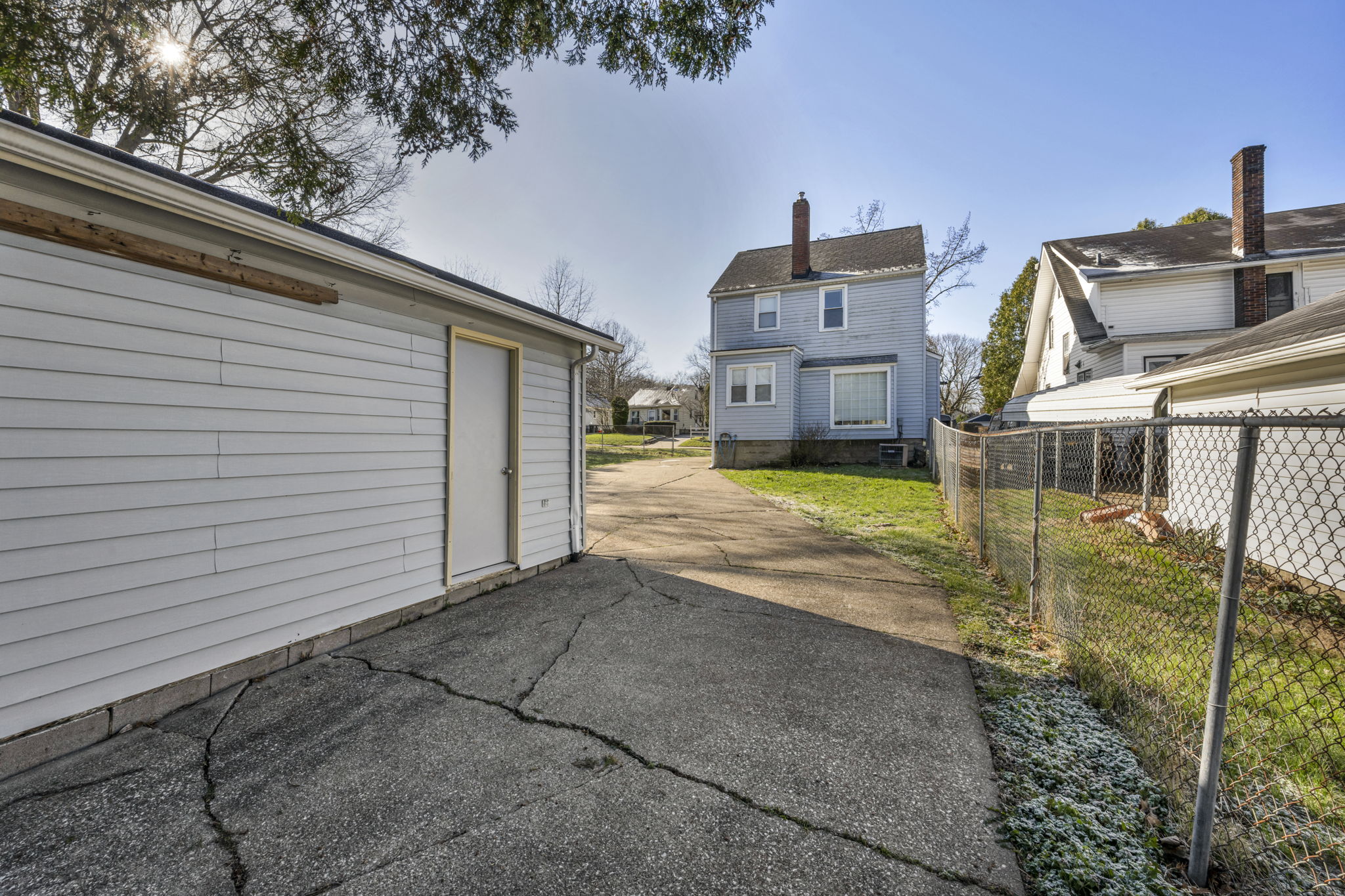
If you've called more than one cash buyer about the same house, you've probably noticed the offers weren't close. One says $58,000. Another says $71,000. A third won't give a number until they've walked it. Same house, same week.
That spread isn't random, and it isn't a negotiating trick. Cash buyers all run some version of the same arithmetic, but they plug in different assumptions, and one category of “buyer” isn't planning to buy at all. We buy houses in Akron for a living, so this is our own math laid out on the table. Once you can see the formula, you can tell which kind of buyer you're talking to, and you can check whether a number you've been handed is fair or lazy.
It starts with what the house is worth fixed up
Every offer works backward from one figure: the after-repair value, or ARV. Not what your house is worth today in its current condition. What it would sell for on the open market after someone put money into it.
This is the number sellers are most often surprised by, in both directions. People who've watched Akron prices climb sometimes expect their ARV to match a renovated comp three streets over with a finished basement. Others underestimate badly, because they're thinking about what they paid in 1998.
A buyer establishes ARV from recent sales of comparable, updated homes in the same submarket: ideally within half a mile, sold in the last six months, similar square footage and bed and bath count. In Akron, where the housing stock changes character block by block, the submarket matters a lot. A 1920s bungalow in Goodyear Heights and one in Firestone Park can be structurally near-identical and carry different ARVs.
Everything below is subtracted from that number.
What comes out of it
Four things, in order of size.
Repairs. The largest and most contested line. This is not what a homeowner would spend to make a house comfortable. It's what a buyer has to spend to make it match those comps. Roof, furnace, electrical panel, plumbing, windows, kitchen, bath, flooring, paint. On an older Akron home that's been lived in for decades without major systems work, $35,000 to $60,000 is ordinary, and it's not unusual for the sewer lateral or the knob-and-tube wiring to add another $10,000 nobody saw coming. If you're curious where that money does the most good, we wrote up which renovations earn their keep.
Holding costs. Property taxes, insurance, utilities, and lawn care for however long the work takes. A four to six month rehab in Summit County typically runs $2,000 to $3,000 all-in. Small, but real, and it's why buyers care about how fast they can start work.
Transaction costs. Title work and recording fees on the way in. Summit County also charges a conveyance fee of $4 for every $1,000 of sale price, plus 50 cents a parcel. It's charged to the seller, though plenty of cash buyers agree to cover it. If the buyer intends to resell, add agent commission and closing costs on the way out, usually 7 to 8 percent of the resale price. On a $145,000 house that's over $10,000.
Margin. The buyer's pay for capital, risk, and roughly six months of work. Anyone telling you they don't build in a margin is either lying or about to go out of business.
A real Akron example
Take a three-bedroom, one-bath bungalow near Kenmore Boulevard. Original kitchen, original bath, furnace on borrowed time, roof at the end of its life, no updates since the Clinton administration. Renovated bungalows in the same pocket of Kenmore are selling around $145,000.
Here's what a buyer planning to renovate and resell would run:
- After-repair value: $145,000
- Repairs: minus $45,000
- Holding costs, 5 months: minus $2,300
- Buy-side closing: minus $1,500
- Sell-side closing and commission: minus $10,000
- Target margin: minus $25,000
- Offer: $61,200
A seller looking at $61,200 against a $145,000 comp feels lowballed. But roughly $59,000 of that gap is money going into the house and into the transaction, not into anyone's pocket. The actual margin is $25,000 on about six months of work, with the roof, the sewer line, and the resale market all sitting on the risk side of the ledger.
That doesn't make the offer generous. It makes it explainable, which is a different thing, and the thing you should be able to demand.
The 70% rule, and why it's a shortcut rather than a law
You'll see the “70% rule” everywhere: offer 70 percent of ARV minus repairs. On the house above that's $101,500 minus $45,000, or $56,500.
It lands in the neighborhood of the itemized number, which is why it survives as a rule of thumb. But it squeezes the four line items above into one blunt percentage, and it breaks in both directions. On a low-priced house, the fixed costs eat a much larger share of the deal, so real offers come in under what the 70% rule suggests. On a higher-priced house in a fast-moving pocket, 70% leaves money on the table that a competing buyer will happily pay you.
If a buyer quotes you a rule-of-thumb number, ask for the itemization. A buyer who has actually underwritten your house can produce it in about a minute. A buyer who can't hasn't done the work.
The part almost nobody explains: not every cash buyer wants to resell
This is where the spread between offers usually comes from, and it's the most useful thing to understand as a seller.
Some buyers renovate and resell. Their math is the list above: driven by resale value, carrying that 7 to 8 percent cost of selling, plus a lump-sum profit target at exit.
Other buyers renovate and keep the property as a long-term rental. Full disclosure: that's us. West Hill Home Buyers keeps what it buys, and our name stays on the deed. Our return doesn't come from a resale in six months. It comes from rent over years, and from refinancing our capital back out once the work is done. The limit on our offer isn't “what's my profit at resale.” It's “can I refinance at 75 percent of appraised value and still cash flow.” We carry no sell-side commission at all, which frees up about ten thousand dollars of room, but we're capped by the appraisal and by what the house actually rents for. Here's what happens to a house after we buy it.
Neither model reliably pays more. On a property with strong rent relative to value, a buy-and-hold operator can usually go higher, because cash flow carries the deal. On a property in a hot resale pocket where rents lag prices, the flipper wins. The practical takeaway: if the first offer feels low, the second call should be to a buyer with a different business model, not just a different company name.
The third category: buyers who aren't buying
Some of the people making you offers are wholesalers. They put your house under contract, then market that contract to actual buyers and collect a fee for the assignment. They never intend to own it.
Wholesaling is legal in Ohio, and some wholesalers are upfront about it. The problem is structural: a wholesaler doesn't need money to make you an offer, so there's no cost to offering high, tying your house up for thirty days, and then coming back to renegotiate, or vanishing, when they can't find an end buyer. It's the most common reason a cash sale falls apart.
Ohio gave sellers a tool for this in 2026. Under Senate Bill 155, in effect since March 2, 2026 (Ohio Revised Code 5301.95), a wholesaler buying a one-to-four unit home has to hand you a separate written disclosure, in bold type, before you sign a contract. It has to say they're a wholesaler, that they don't represent you, that they may assign the contract to someone else for a profit, and that the price may be below market value. You both sign and date it. If they skip it, you can cancel any time before closing with no penalty, and the closing agent has to pay their earnest money over to you within 30 days.
So the first question is simple: where's the disclosure? Three more questions separate buyers from middlemen, and none require any expertise to ask:
- Are you the entity that will be on the deed at closing?
- Can you send proof of funds dated this week?
- Does your contract permit assignment, and will you strike that clause?
An actual buyer answers all three without friction. Hesitation on the third is the tell.
Sanity-checking the number you've been given
- Ask for the ARV and the comps behind it. Three addresses, sold within six months, within half a mile. If the comps are stale or across town, the whole calculation is built on sand.
- Ask for the repair scope, not just the total. A line-item list is checkable. A single number isn't.
- Ask who pays closing costs. Title fees and the county conveyance fee are real money on a small sale. Get it in writing which side covers them.
- Get a second offer from a different business model. One reseller, one buy-and-hold operator.
- Compare against a net, not a gross. The $145,000 figure is the fixed-up price. Listed as it sits, the same house might bring somewhere in the $80,000s from a buyer willing to take on the work, since most financed buyers can't close on a house with a failing roof and furnace. Take off 6 to 7 percent for commission and closing, a few months of taxes and utilities, and whatever the inspection knocks loose, and you're comparing a number in the $70,000s a few months from now against $61,200 in a couple of weeks. That's the honest comparison, not $145,000 against $61,200.
When the discount makes sense, and when it doesn't
If your house is in decent condition, you're not under time pressure, and you can handle showings and a financing contingency, list it. You'll net more. That's not a close call, and any honest buyer will tell you the same.
The cash discount buys you certainty, speed, and freedom from the repair and cleanout burden. That's worth real money when the repair number is large, when the house is full of belongings you don't have the time or heart to sort, when heirs live in different states, when a foreclosure date is on the calendar, or when the property simply needs to be resolved so everyone can move on.
What you should never accept is a number without an explanation behind it. The arithmetic isn't complicated and it isn't secret. Any buyer worth selling to will walk you through it line by line, and the ones who won't have told you something useful about themselves.
If you want to see this math run on your own house, West Hill Home Buyers will put every line in front of you, including the ones that don't flatter us. Here's how our process works.