
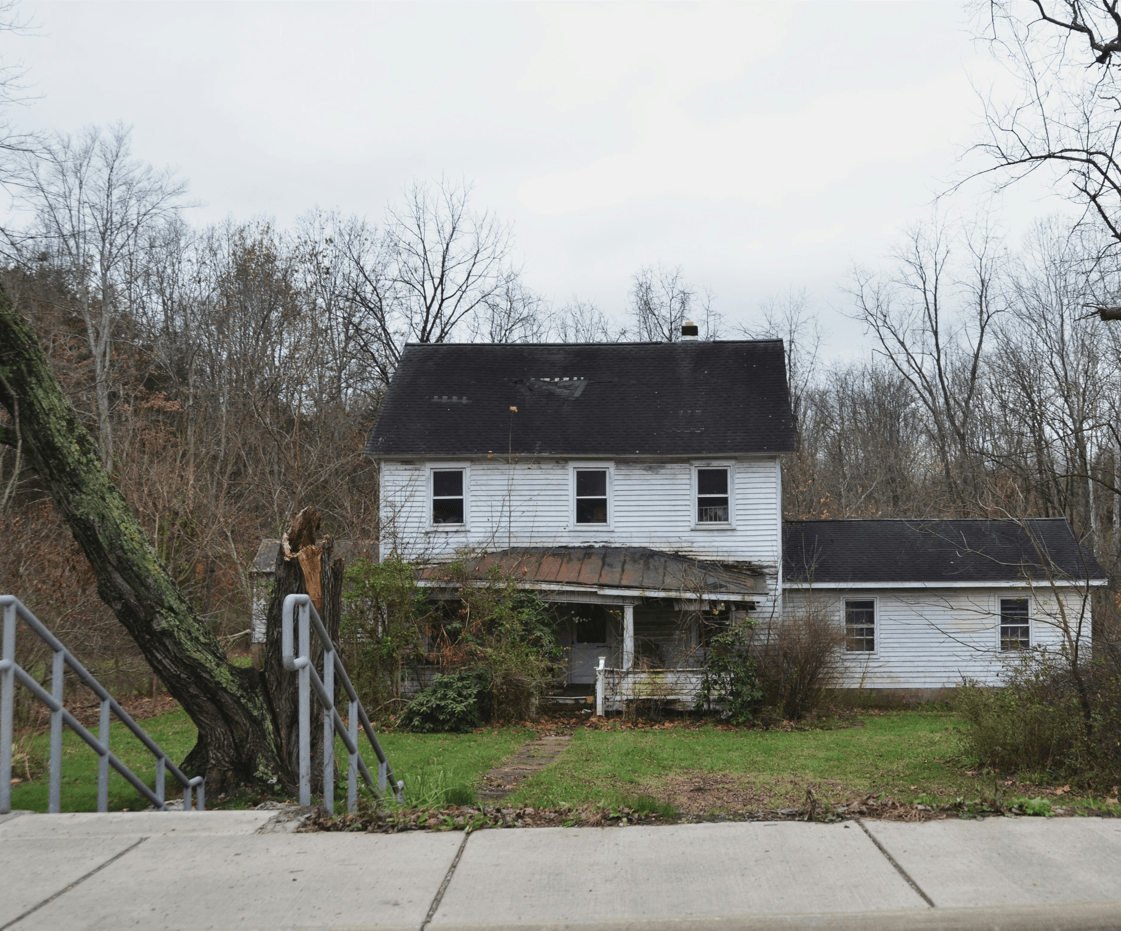
Almost nobody plans to be in this situation. It arrives slowly, and usually through somebody else's life.
A mother dies and the house she'd been in for fifty years turns out to be full to the ceiling in three rooms. A brother's depression got worse quietly for a decade. A father with dementia stopped throwing anything away, and the family only found out when the furnace failed and the repair tech couldn't reach it.
Then a neighbor calls 3-1-1, and a notice from the City of Akron shows up in the mail.
We buy houses across Akron and Summit County, and we've bought properties that hadn't been emptied in forty years. This is what actually happens on the city side, what your real options are, and why the cleanout is the part you can most easily skip.
A note before the practical part
Hoarding is a recognized mental health condition, not a housekeeping failure. It is not laziness and it usually isn't a choice in any meaningful sense. Most of the families we talk to are carrying a load of shame that isn't theirs to carry — about the house, about not noticing sooner, about what the neighbors think.
None of that helps you decide what to do with the property. But it's worth saying out loud, because a lot of the writing on this subject treats the situation as a joke, and it isn't one.
How Akron's process actually works
Akron's Housing Compliance Division enforces the Environmental Health Housing Code. Violations get found three ways: citizen complaints, referrals from other agencies, and inspectors simply noticing things in the area they cover.
Once a complaint comes in, an inspector investigates. If there's a violation, the city issues an order to repair with a specific compliance date.
The city's own guidance is blunt about what to do with that notice, and it's the right advice: don't ignore it. If you can't correct the violations by the deadline, you're expected to contact the inspector handling your case and request an extension.
Read that again, because it's the part people miss. There is a human being assigned to your case, and asking for more time is a normal, expected part of the process. The city would rather grant an extension than start a legal file.
What happens if you do nothing: reinspections, administration fees, and eventually legal proceedings brought in consultation with the city's Department of Law, plus fines. Akron is currently debating adding civil citations as a middle step between the repair order and criminal charges — which tells you something about how wide that gap currently is.
The single most expensive thing you can do with a repair order is put it in a drawer.
What inspectors can and can't do
Worth knowing, because a lot of people assume the worst.
In Ohio, a code enforcement officer generally needs either your consent or an administrative warrant to enter a private residence. Nobody is walking through your late mother's house because a neighbor complained.
What is fair game is anything observable from outside — exterior clutter, odors, pest activity, an overgrown lot. Akron's separate Nuisance Compliance Division handles the grass and weeds ordinance, which was written with vacant lots and empty houses in mind. If the property is unoccupied and the yard gets away from you, that's usually the first notice a family receives.
You can also appeal. An order to comply can be appealed to the Director of the Department of Neighborhood Assistance with a request for a hearing.
Condemnation is not the end, but it is a different situation
Under Akron's housing code, a dwelling condemned as unfit for human habitation gets placarded, has to be vacated within a reasonable time as ordered by the Housing Inspector, and is formally declared a public nuisance — which then has to be repaired, vacated, or demolished.
Two practical consequences.
First, a placarded house can't be occupied until the violations are corrected and it passes reinspection. That's a hard stop on any plan involving a tenant or a family member moving in.
Second, and more expensive: if a property deteriorates far enough, a municipality can move toward demolition under Ohio's nuisance abatement laws, and the cost of that demolition typically gets assessed as a lien against the property. Demolition liens commonly run five figures. That's a bill attached to a lot you no longer have a house on.
Selling well before that point is a materially different financial outcome than selling after.
The insurance problem nobody warns you about
If the house is empty — after a death, after a condemnation order, while a family decides what to do — the coverage picture changes.
Standard homeowner's policies typically restrict or exclude coverage once a property has been vacant for a stretch, often 30 or 60 days depending on the policy. A house full of belongings with nobody living in it is, for insurance purposes, usually still vacant.
So the frozen pipe in January, or the fire, or the break-in, may not be covered — and if the estate is still the owner of record, that's the estate's problem.
This is worth one phone call before it becomes real. Broadway Insurance Services is licensed in Ohio and handles exactly this kind of question — their home insurance and coverage situations pages explain how vacancy provisions work and what to do about a property sitting empty. Ask specifically about vacancy endorsements, because that's the gap.
What a cleanout actually costs you
Families usually assume the house has to be emptied before it can be sold. So they price a cleanout, and the number lands somewhere between uncomfortable and impossible.
But look at what you're buying with that money. You pay to remove the contents, then you pay to fix whatever the contents were hiding — and there is almost always something. Floors that took decades of weight. A roof leak nobody could get to. Pest damage. Wiring that was never right.
Then, after all of that, you list a house that still needs work, into a market of buyers who will look at the compliance history and negotiate accordingly.
The cleanout rarely returns what it costs. It mostly buys the family the feeling of having handled it properly — which is not nothing, and if that's what someone needs in order to grieve, it's a legitimate reason. Just don't mistake it for a financial decision.
The thing worth taking from the house
One practical note that matters more than any of the above.
Before anything happens — cleanout, sale, anything — walk the house for documents and photographs. Deeds, insurance policies, savings bonds, military records, letters, albums. In houses like these, the important paper is almost never where you'd expect, and it does not survive a dumpster.
Everything else is replaceable. That isn't.
Selling without emptying it
We buy houses in this condition as they are. Take what matters to your family and leave the rest — furniture, papers, appliances, whatever is in the basement and the garage. We handle disposal.
We walk the property ourselves before giving you a number, so what's in it and what's under it are already priced in. There's no renegotiation at day twenty when somebody finally sees the back bedroom. Code balances, liens and back taxes get settled at closing through a local title company.
And we keep what we buy — we don't flip and we don't wholesale. A house like this becomes a long-term rental on a block we're invested in, which is a better outcome for the neighbors who called 3-1-1 in the first place.
If you want a straight number on a property in this shape, here's how our process works, or call or text (330) 661-9885. If the house is part of an estate, our inherited property guide covers the probate side.
Akron contacts
- Housing Compliance Division — 330-375-2366 · HousingCodeComplaints@akronohio.gov
- Report a potential violation — 3-1-1
- City of Akron — Housing Compliance Division
- City of Akron — Nuisance Compliance Division
We buy and renovate houses in Summit County; we're not attorneys, and nothing here is legal advice. Code enforcement outcomes depend on the specific violations and dates in your case — talk to the inspector assigned to it, and to a lawyer if a legal filing has already happened.