
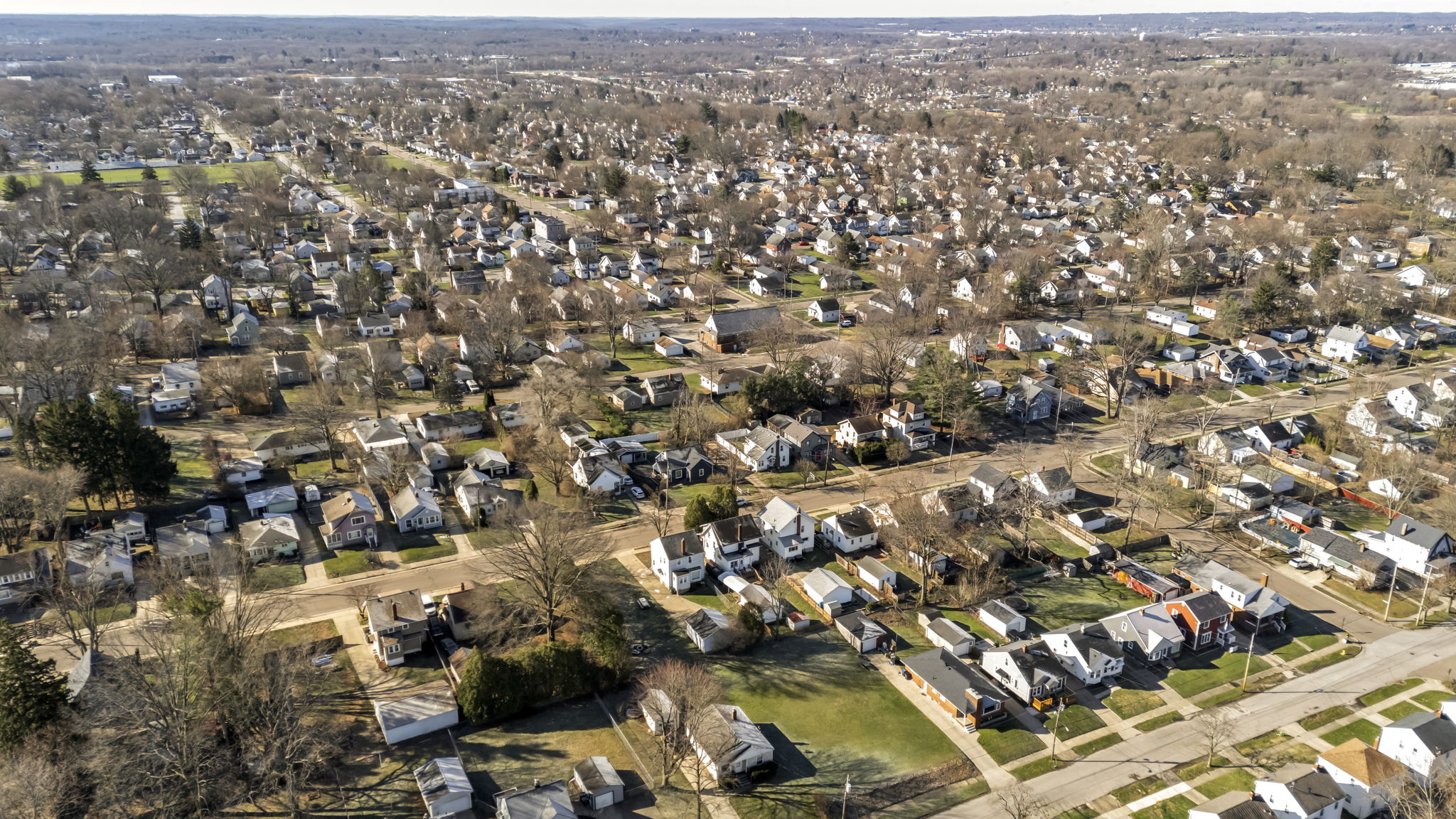
On September 2, the City of Akron and the Summit County Land Bank released the Made in Akron plans: ten free, pre-reviewed house designs meant to get new homes built on the city's empty lots. The Narrow Lot Home is drawn for a 30 by 100 lot. The Standard Lot Home fits a 38 by 100. The Two-Family Home fits a 46 by 100.
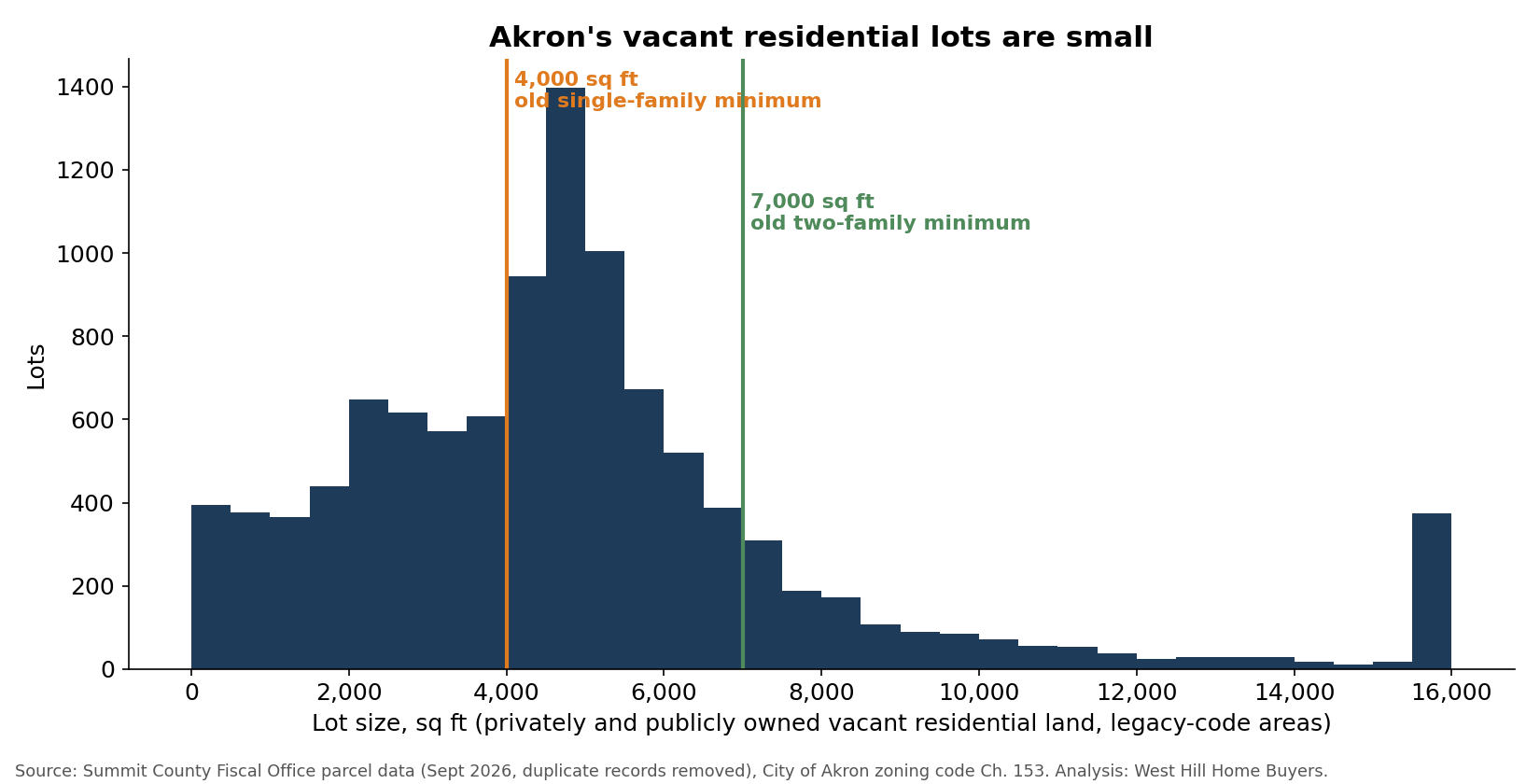
Those are the lots Akron actually has. The zoning code is the one piece that had not caught up: as written, a house needs 4,000 square feet and two units need a lot 60 feet wide and 7,000 square feet, so anything smaller means a Conditional Use hearing.
Twelve days later, the administration sent Council the other half of the same effort: legislation to erase the minimums. The public hearing is Monday, September 28 at 5 p.m. We pulled every one of the city's 95,539 parcels from the Summit County Fiscal Office to answer the question that hearing is really about: how much of Akron does this unlock, where is it, and who owns it?
The short version: it unlocks a lot, mostly in the neighborhoods that have lost the most houses, and the city itself owns hundreds of the lots. We think that is good news, and we say why near the end. The numbers come first so you can judge for yourself.
Key findings
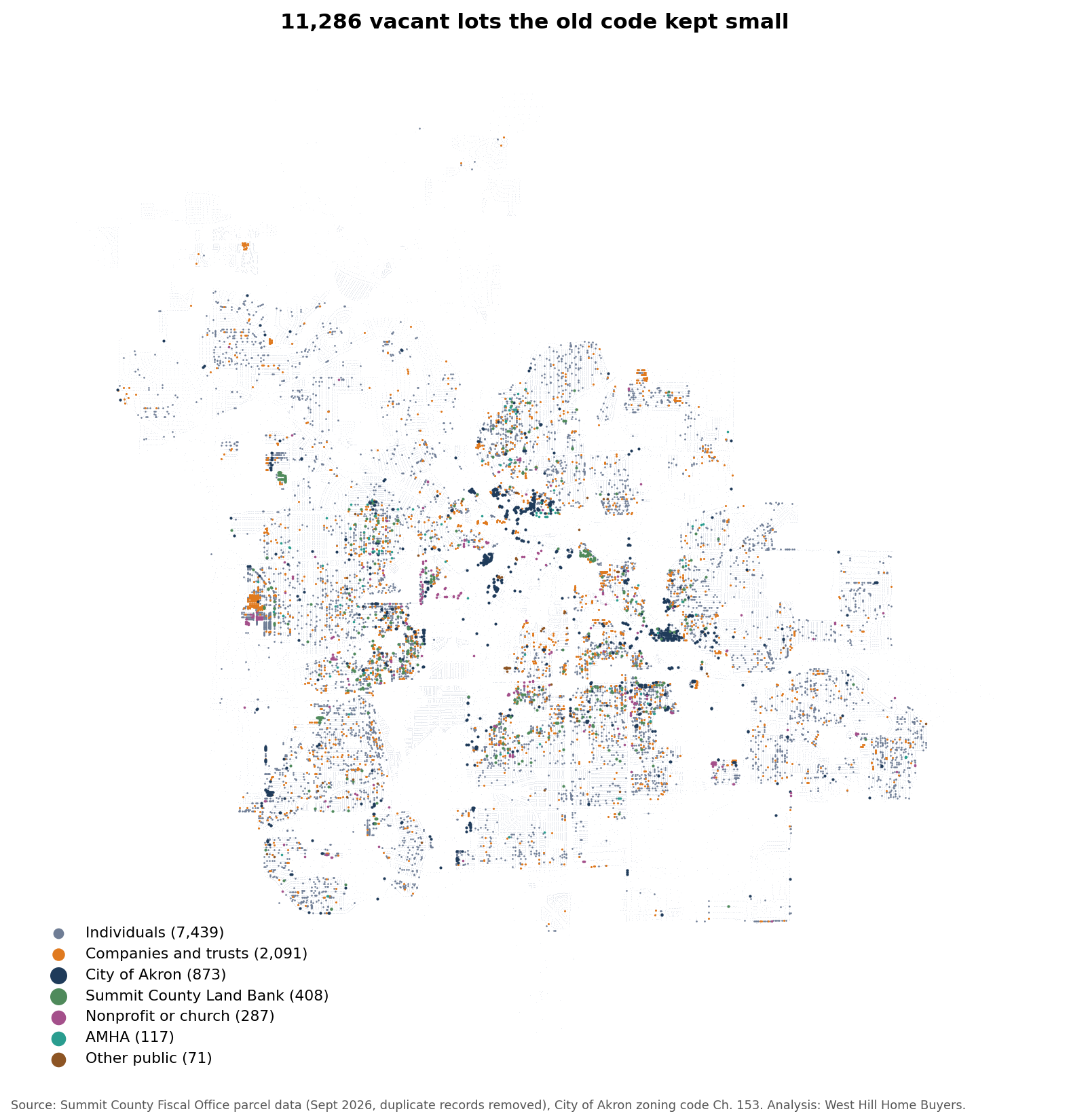
- 11,286 vacant lots in Akron's legacy-code neighborhoods fall under the old minimums. 4,706 are too small for a house under the current rule. Another 6,580 are big enough for a house but too small or too narrow for two units.
- 5,481 of them are practical building lots that are not somebody's side yard. The typical one is 4,440 square feet and 40 feet wide: a 40 by 110.
- The city owns 873 of the unlocked lots. The Summit County Land Bank owns 408. Of the city's lots, 383 are under 4,000 square feet, the ones its own Narrow Lot and Standard Lot plans were drawn for.
- 7,658 unlocked lots fit the city's Narrow Lot Home. 2,264 fit the Two-Family Home. Of every vacant lot in the city where the city's own duplex plan fits, nearly two thirds were off limits under the old rule.
- 82% of Akron's existing two- and three-family homes (3,066 of 3,758) sit on lots the code says are too small for a two-family home. 4,594 houses sit on lots under 4,000 square feet. If one is lost, the owner generally has two years to rebuild before the lot falls under today's minimums. In Middlebury, that is 40% of single-family homes.
- Seven in ten Akron single-family homes sit on a lot where a second unit was blocked by lot size alone. The median Akron house lot is 6,100 square feet and 50 feet wide, under both two-family minimums.
What the rule is, and what changes
Akron's legacy zoning code, the one that still governs every neighborhood outside Merriman Valley and Summit Lake, sets two floors. A single-family house needs a lot of at least 4,000 square feet. A two-family home, or anything with more units, needs a lot at least 60 feet wide at the building line and at least 7,000 square feet. The city's own planning staff wrote in June that houses on lots below that threshold exist “in nearly every core neighborhood in Akron,” and that in a few cases whole blocks are made up of them.
If your lot is smaller, you can still ask. The Conditional Use route means an application fee, a wait of months, and a site plan, a building layout and elevation drawings paid for before anyone tells you yes or no. Most builders don't ask. They buy a different lot, or they don't build.
The legislation introduced to Council on September 14 (Planning Commission case PC-2026-20-T) removes the minimums entirely, so long as the house meets the yard rules. Those get simpler too: a 15-foot rear yard and 5-foot side yards for one- to three-family homes in any district. The extra rules that applied only to two-family homes (6-foot side yards adding up to 18, a front door for each unit facing the street) go away. Apartment buildings must keep 10% of the lot as open space instead of 30%. Driveways can be 9 feet wide instead of 10.
Two things it does not do. It does not change which zoning districts allow two or three units; that is a separate proposal headed to the Planning Commission in October. And it does nothing in Merriman Valley or Summit Lake, which already run on a form-based code with no minimum lot size.
The plans are ready. The code is catching up.
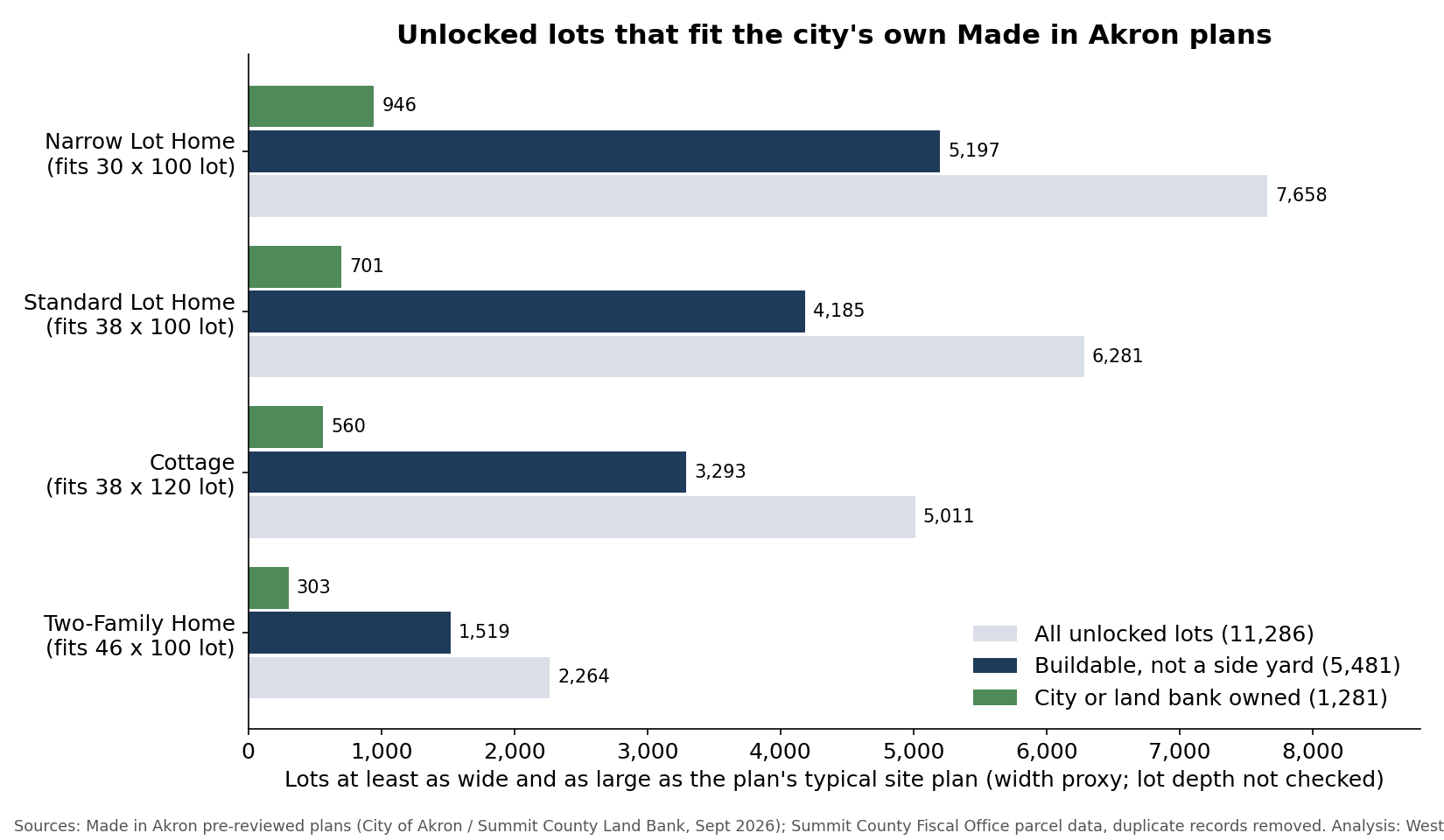
The Made in Akron plans were designed, in the city's words, “to fit on the different size lots that are available in the city.” That turns out to be the whole argument for the repeal, in one sentence. The Narrow Lot Home's typical site plan is 30 by 100 feet, or 3,000 square feet. The Standard Lot Home's is 38 by 100, or 3,800. Both are under the 4,000-square-foot minimum. The Two-Family Home's is 46 by 100, or 4,600 square feet: 14 feet too narrow and 2,400 square feet too small for the two-family rule.
Across the city's legacy-code neighborhoods there are 2,924 vacant residential lots at least 46 feet wide and 4,600 square feet, where the city's duplex would fit. Only 1,057 of them meet the 60-by-7,000 rule. The other 1,867 were off limits without a hearing.
We asked the City of Akron's communications office for comment and for the city's own count of these lots. We will update this page when we hear back.
How many lots, and where
The vacant lots the old code kept small are not evenly spread. They sit where the houses were densest a century ago and where the most houses have come down since.
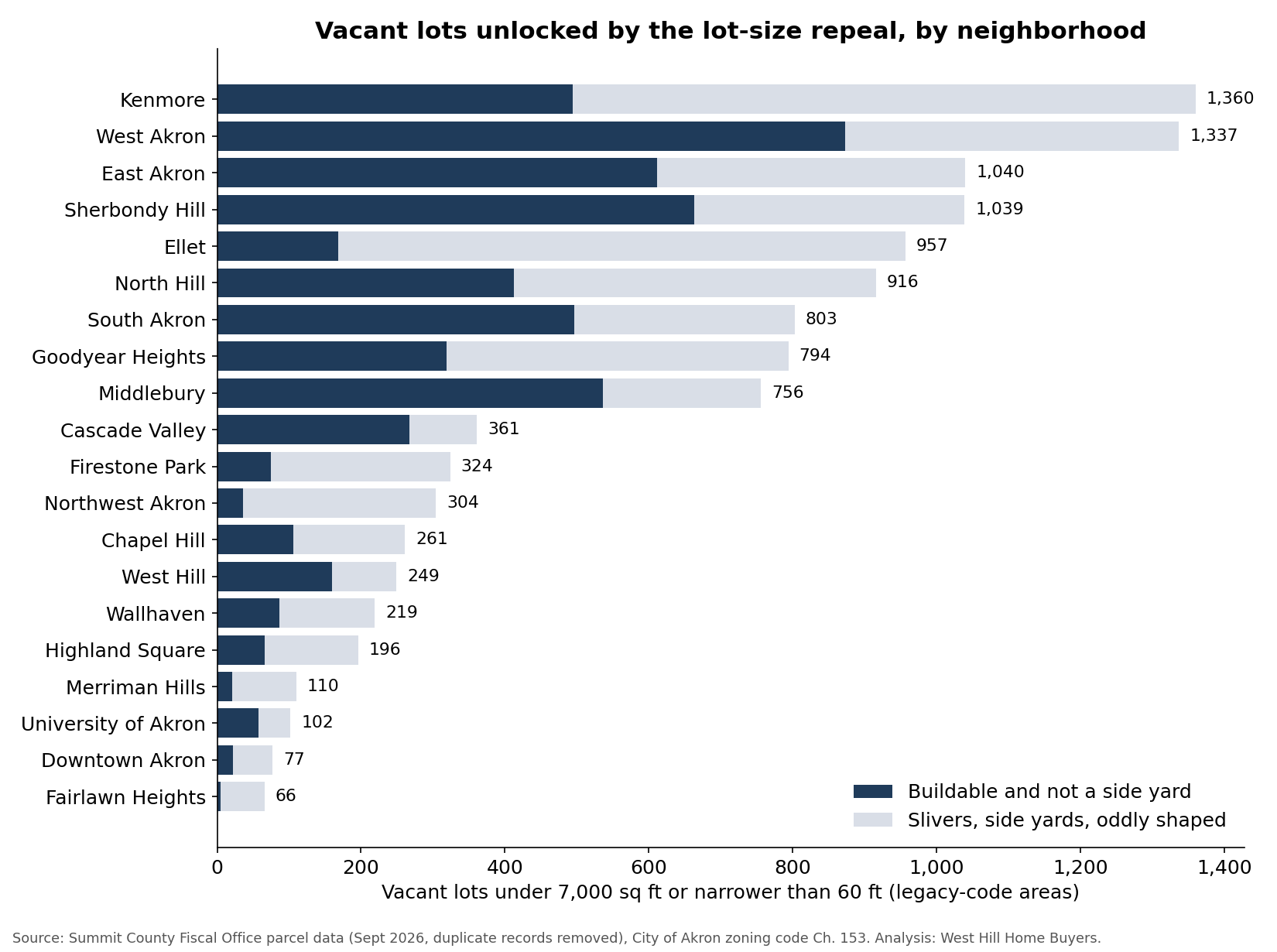
Unlocked lots by neighborhood (total, then the practical lots that are not a side yard):
- Kenmore: 1,360 lots, 494 practical
- West Akron: 1,337 lots, 873 practical
- East Akron: 1,040 lots, 612 practical
- Sherbondy Hill: 1,039 lots, 663 practical
- Ellet: 957 lots, 168 practical
- North Hill: 916 lots, 412 practical
- South Akron: 803 lots, 496 practical
- Goodyear Heights: 794 lots, 319 practical
- Middlebury: 756 lots, 536 practical
- Cascade Valley: 361 lots, 267 practical
- Firestone Park: 324 lots, 75 practical
- Northwest Akron: 304 lots, 36 practical
- Chapel Hill: 261 lots, 106 practical
- West Hill: 249 lots, 160 practical
- Wallhaven: 219 lots, 86 practical
- Highland Square: 196 lots, 66 practical
- Merriman Hills: 110 lots, 21 practical
- University of Akron: 102 lots, 58 practical
- Downtown: 77 lots, 22 practical (mostly plaza and parking land around South Main)
- Fairlawn Heights: 66 lots, 5 practical
Kenmore and Ellet have the most lots by count, but most of theirs are slivers, odd shapes, or the yard next to somebody's house. West Akron, Sherbondy Hill, East Akron, Middlebury and South Akron hold the deep supply: about 3,200 practical lots between them. Measured against the houses around them, the change lands hardest in Sherbondy Hill (47 unlocked lots for every 100 homes) and Middlebury (46).
We have written separately about what is changing in Kenmore, Goodyear Heights, Firestone Park, North Hill, Highland Square, Chapel Hill, Ellet and Wallhaven.
By council ward, Ward 5 leads with 2,303 unlocked lots, followed by Ward 3 (1,508), Ward 4 (1,373), Ward 9 (1,359) and Ward 10 (1,355).
Who owns them
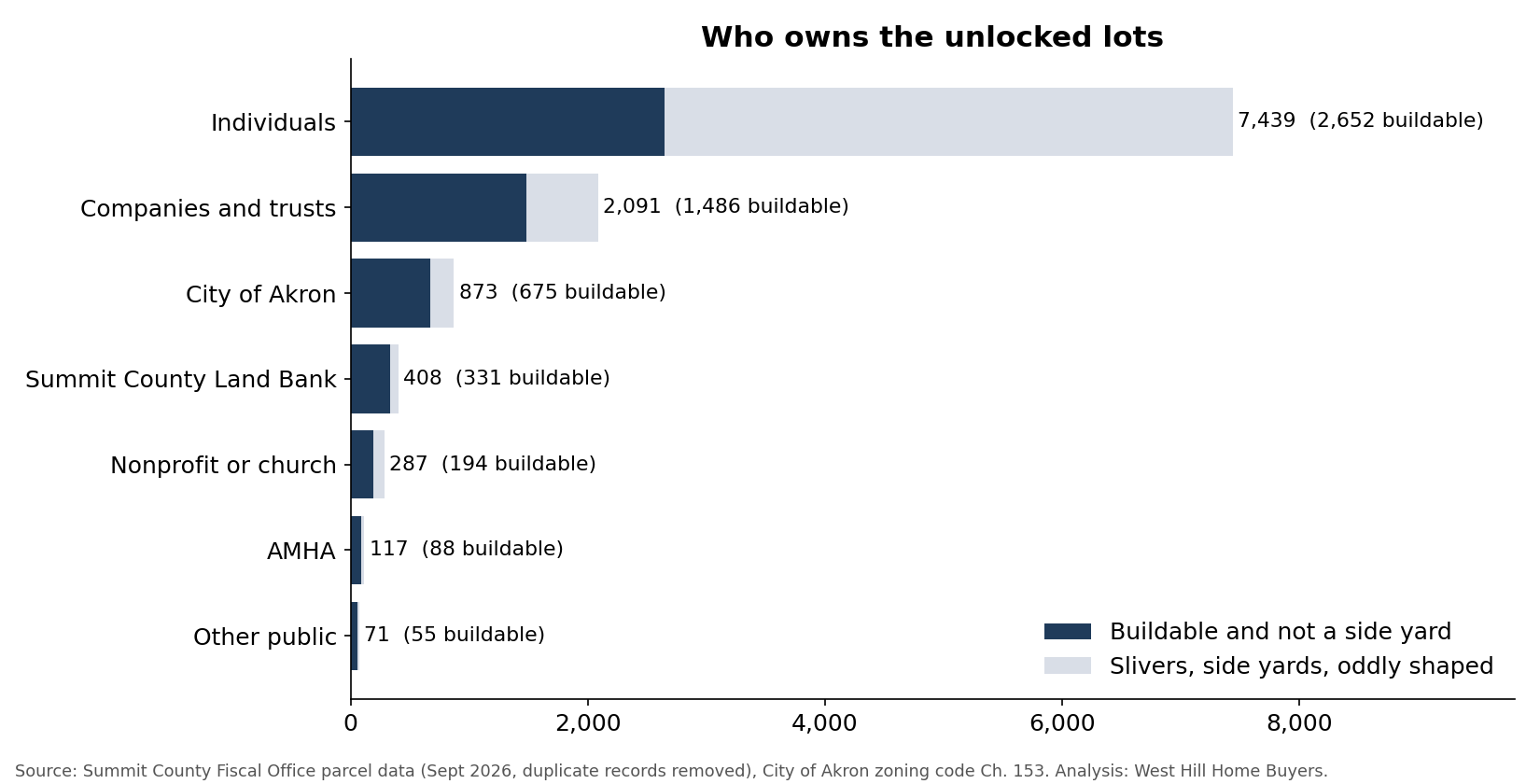
- Individuals: 7,439 lots. 2,652 are practical and not a side yard.
- Companies and trusts: 2,091 lots, 1,486 practical.
- City of Akron: 873 lots, 675 practical. 383 are under 4,000 square feet.
- Summit County Land Bank: 408 lots, 331 practical.
- Nonprofits and churches: 287 lots, including 20 held by Habitat for Humanity of Summit County.
- Akron Metropolitan Housing Authority: 117 lots.
- Other public bodies: 71 lots.
The city and the land bank together hold 1,281 of the unlocked lots, and 946 of those are big enough for the Narrow Lot Home. The city has said it holds “hundreds” of vacant lots under 4,000 square feet that used to have houses on them. The parcel data puts the number at 383 in the legacy-code neighborhoods, plus 150 more in Summit Lake and Merriman Valley where the minimums already don't apply. That is our count from county parcel records. We sent it to the city's planning staff for validation and will update it if the city provides its own figure.
The county's combined market value of all 11,286 lots is $121.8 million. The median lot is valued at $10,340.
The houses already standing on small lots
The repeal is usually described as a vacant-lot fix. It is also a fix for houses that already exist.
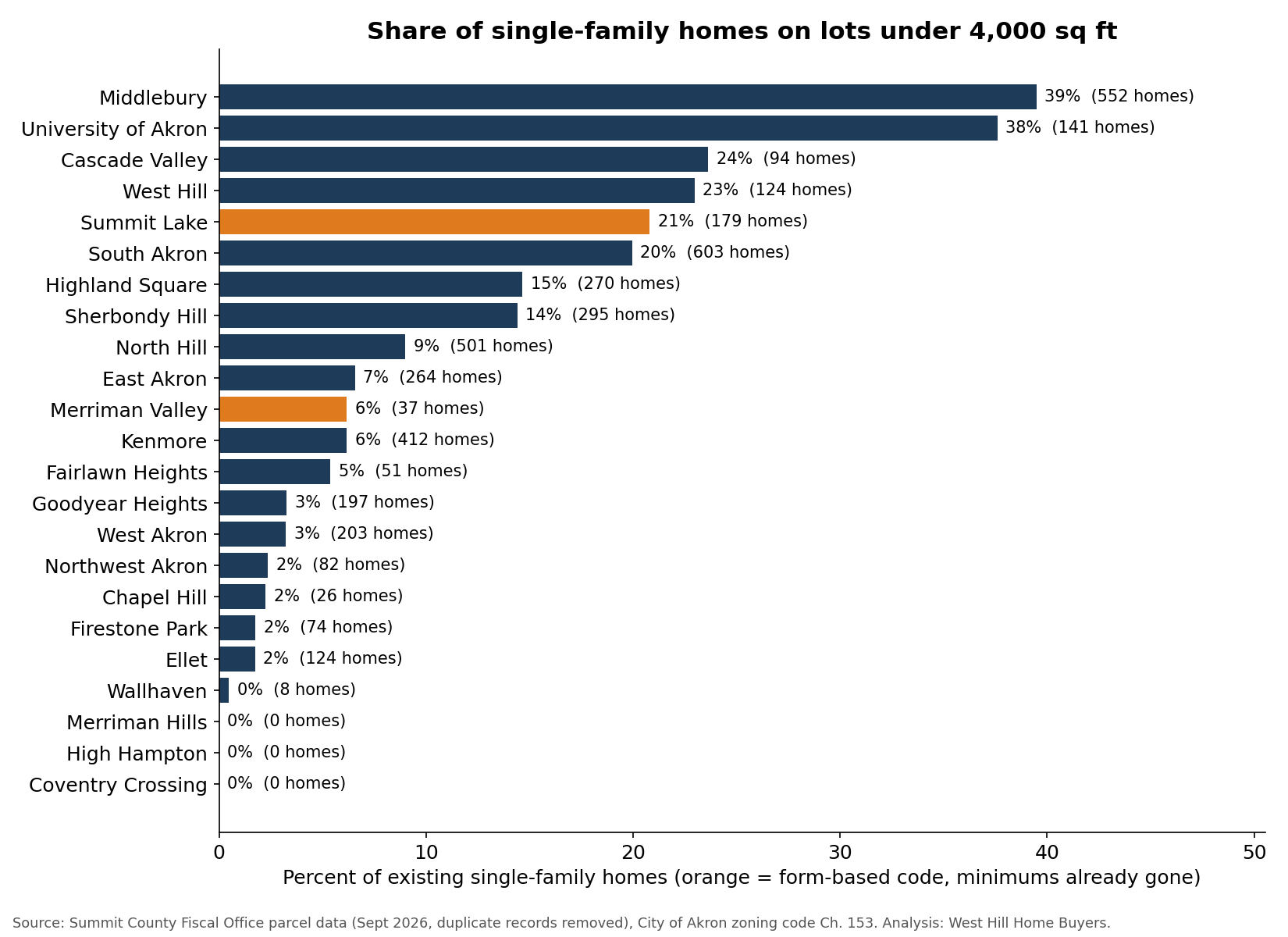
Of Akron's 63,915 one- to three-family homes, 4,594 sit on lots under 4,000 square feet. If one of them burned down tomorrow, the owner would generally have two years to rebuild under Ohio's nonconforming-use rules. Miss that window, or buy the lot after the house is gone, and it has to meet today's minimums. In Middlebury, 40% of single-family homes are on sub-4,000 lots. In the University of Akron neighborhood it is 38%. Cascade Valley is at 24%, West Hill at 23%, South Akron at 20%.
The duplex numbers are starker. Akron has 3,758 two- and three-family homes. 3,066 of them, 82%, sit on lots below the two-family minimum: narrower than 60 feet, smaller than 7,000 square feet, or both. The rule never matched the duplexes Akron already has, and the repeal brings the code back in line with them.
And the median Akron single-family lot is 6,100 square feet and 50 feet wide. That fails both two-family tests. 43,458 single-family homes, about seven in ten in the city, sit on lots where adding a second unit was blocked by lot size alone, before anyone got to the question of whether the zoning district allows it.
What a builder actually runs into
In July we put together the whole Conditional Use packet for a two-family home on a normal Akron lot: application, site plan, structure plans. Then we didn't file it. Twenty-five hundred dollars and three months for a maybe, on a rule the city was already saying it wanted gone. We're still waiting on that lot, and so is the seller.
Our own duplex is going up in Springfield Township, under Summit County building standards, so it is not an example of Akron's code. But it is an example of the math the repeal opens up on Akron lots: two 1,048-square-foot units, two bedrooms and two baths each, for under $300,000 all in, including the land. One side pays for the other. That is the model a multigenerational family or a first-time buyer with a tenant can use, and until the minimums go, it is the model the code blocks on most of the city's lots.
What it means if you own a house here
If your lot is under 4,000 square feet, and 4,594 Akron houses are, the repeal takes the clock off the table. You, or whoever buys from you, could rebuild, add on, or build new without a hearing, no matter how long the lot has been empty. If your lot is under 7,000 square feet or 60 feet wide, and most Akron lots are, it removes the size objection to a second unit. Whether your district allows a second unit is the next question, and the administration has said that proposal reaches the Planning Commission in October.
For the city, it means 873 lots it already owns can go out with a free plan set and no variance attached. For the land bank, 408 more.
The full list of unlocked lots, with size, width, neighborhood, ward, owner type and county value, is available on request. Individual owners' names are withheld.
Our take: this is a good thing
Everything above is counting. Here is what we think it adds up to.
Credit where it is due. The city released free plans for small lots and then moved to change the code so they can actually be built. That is the right order of operations, and we are for it.
Akron does not have a land problem. It has thousands of empty lots on streets that already have water, sewer and sidewalks, and a code that made most of them hard to build on. Many of those lots had a house on them once. Letting someone put a house back is about as low-risk as housing policy gets.
The repeal will not fix affordability by itself. In a lot of these neighborhoods a new house still costs more to build than it sells for, and no zoning change fixes that math. What helps is the second unit. Live in one side, rent the other, and the rent covers the gap. I got my own start that way, and Akron already has 3,066 duplexes and triplexes sitting on lots this size. The model is not new here. The code just stopped allowing it.
More homes will not drop prices overnight, and nobody should promise that. But every house built on one of these lots is one more place to live on a block that has been losing them, and one more lot paying taxes again. The repeal does not build anything. It just stops the code from being the reason nobody does.
We own one of these lots ourselves, next to our duplex in Kenmore. Under the current code it can't hold a second two-family home without a hearing. Under the proposed one, the city's own plan fits.
Related reading
- Who Owns Akron's Condemned Houses? Two Years of Housing Appeals Board Records
- Akron Vacant and Abandoned Property Statistics 2026
- Akron Housing Market Statistics 2026
Methodology
Parcels. All 95,539 records in the City of Akron tax district, from the Summit County Fiscal Office tax-parcel layer published on the County of Summit GIS open data portal, pulled September 13, 2026. The layer returned 1,655 exact duplicate records (same parcel number, attributes and shape); these were removed, leaving 93,884 unique parcels. Lot area is the parcel polygon's area in Ohio State Plane (feet); it matches the county's own stated acreage within 5% for 99.5% of parcels, and only three vacant lots change category at the 7,000-square-foot line. Lot width is the short side of the tightest rotated rectangle around the parcel, a proxy for width at the building line; it can understate width on irregular lots.
Thresholds. From Chapter 153 of the Akron zoning code and Planning Commission case PC-2026-20-T (June 15, 2026): 4,000 square feet for a single-family dwelling; 60 feet wide and 7,000 square feet for two or more units. A lot is counted as “unlocked” if it is under 7,000 square feet or narrower than 60 feet.
Vacant lots. Parcels with no building value, no year built and no building area in county records; residential vacant land (land-use code 500) under any owner, plus tax-exempt vacant parcels owned by the city, the land bank, AMHA, other public bodies, churches and charities. Excluded: parks, schools, University of Akron land, federal land, cemeteries, commercial and industrial vacant land, condominium land, agricultural land, and parcels over one acre. Summit Lake and Merriman Valley are excluded from the unlocked totals because they are already under the form-based code; they hold another 853 sub-threshold vacant lots. Where the county combines a vacant lot with the house next to it for billing, the lot appears as one shape and is not counted, so the true number of vacant lots is higher than 11,286.
Practical lots. At least 30 feet wide and 2,500 square feet, enough for a modest house with 5-foot side yards under the proposed standards. Raising the bar to 35 feet reduces the count from 8,047 to 7,473.
Side yards. A lot is flagged as a likely side yard when an individual owner also owns a parcel with a building in the same county appraisal neighborhood. It is a proxy; some flagged lots are separate holdings and some unflagged lots are yards.
Made in Akron fit. A lot is counted as fitting a plan if it is at least as wide and as large as the typical site plan printed in that plan set (30 by 100, 38 by 100, 38 by 120, 46 by 100). Lot depth was not checked.
Neighborhoods and wards. Parcel centroids were matched to Akron's 24 neighborhood boundaries (the public ArcGIS layer Reinvestment Fund published for the city's Market Value Analysis) and to the city's 10 ward boundaries.
Owners. Classified by owner name. “Absentee” means the tax-bill mailing address differs from the property address. Individual owners' names are public record but are not reproduced here.
Limitations. Two-family eligibility still depends on the zoning district; these counts measure lot size only. County records change daily. Owner classification by name pattern misfiles a small number of parcels at the margins.
Correction, September 23, 2026. Every figure on this page was recomputed after we found that the county feature service had returned 1,655 duplicate parcel records, and after removing nine city-owned park, sewer and landfill parcels from the lot count. Most counts fell about 1%: the headline went from 11,436 to 11,286 unlocked lots, and city-owned lots from 883 to 873. The single-family second-unit figure was restated to include lots under 4,000 square feet (43,458 homes, 72%), which the original 39,939 omitted. No ranking or conclusion changed. The charts have been updated to match.
The full dataset is available on request. Questions: contact West Hill Home Buyers.
West Hill Home Buyers is a local, family-owned company that buys houses in Akron and Summit County, renovates them, and keeps them as rentals. We are building a two-family home of our own in Springfield Township and have a second waiting on this vote. We built this study because we wanted to know what the number actually was.