
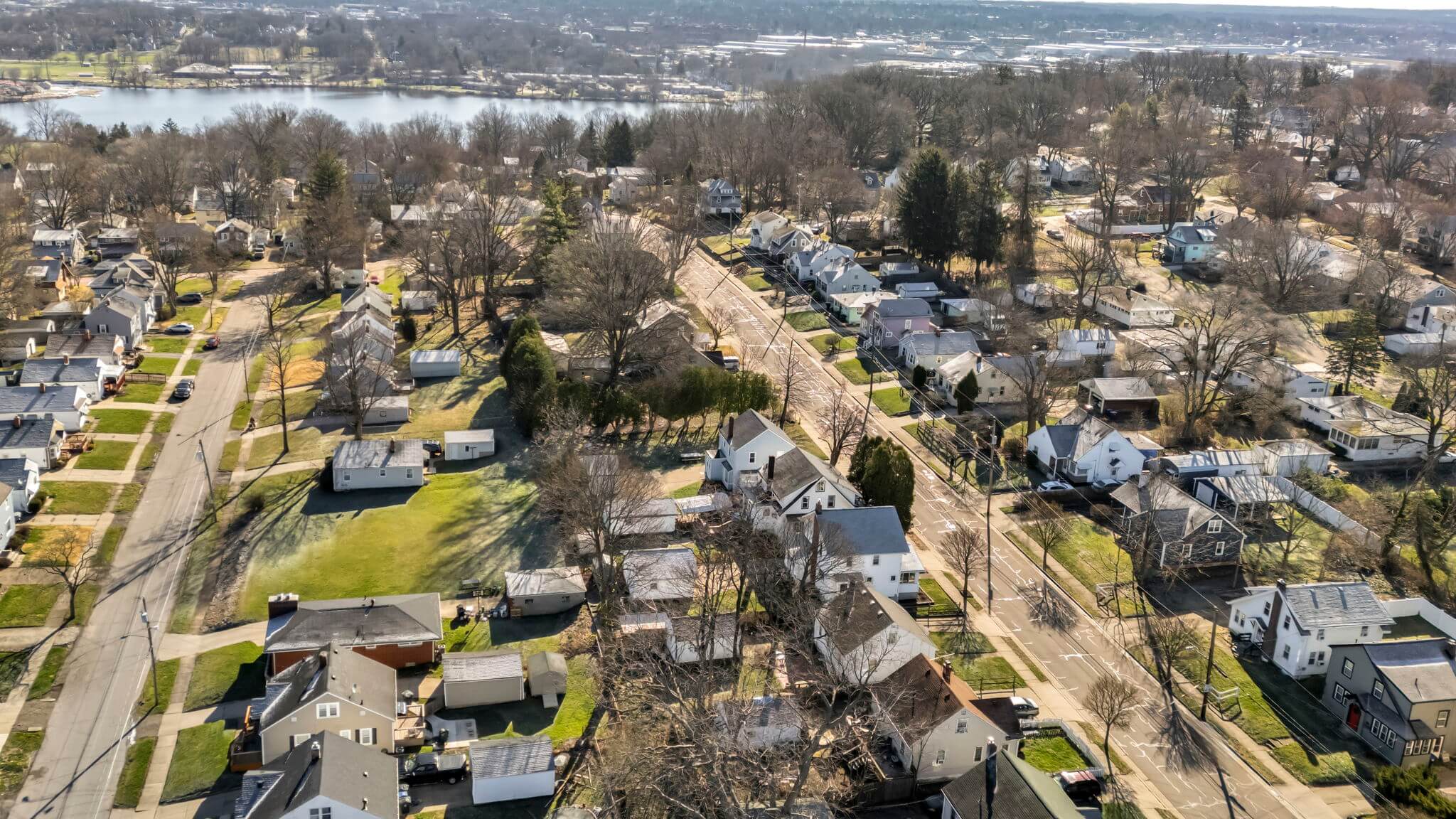
People ask how we buy houses in Akron with cash when they would need a mortgage. The honest answer is that we do use financing. We just use it at the end instead of the beginning.
BRRRR stands for buy, rehab, rent, refinance, repeat. In Akron it runs like this: We buy a distressed property with cash — because no lender will finance a house in that condition — renovates it, leases it, and then, after a six-month seasoning period, takes a DSCR cash-out refinance to recover the capital and buy the next one. A DSCR loan is a business-purpose rental loan underwritten against the property's rent rather than the borrower's income.
It gets talked about like a life hack. It isn't. It's a capital cycle with real constraints, and in a market like Akron the constraints are different than the ones you read about on national forums. This is how we actually run it, including the parts where it doesn't work.
Why BRRRR works in Akron
BRRRR only works where there is a real gap between what a house costs in bad condition and what it's worth stabilized. Expensive markets have thin gaps and huge dollar risk. Akron has the opposite problem, and it's a good problem.
The citywide median sits around $152,000. But Kenmore and West Akron run closer to $91,000, Firestone Park around $105,000, Goodyear Heights and Ellet around $110,000, and Cuyahoga Falls around $190,000. That spread inside one county is the whole opportunity. A house that needs $40,000 of work in a $110,000 neighborhood is a different math problem than the same house in a $500,000 neighborhood, and the rent-to-price ratio here still supports debt after the refinance — which is the part that actually decides whether the deal survives.
Rents in Summit County have held up better than prices in the low end. That's why the Akron housing market keeps attracting out-of-state capital. The difference is that we live here, and we're not selling the house at the end.
Buy: the houses no lender will touch
This is the part most BRRRR explanations skip, and it's the part that creates the margin.
We buy with cash because the properties we buy cannot be financed on day one. Not by a bank, not by a DSCR lender, and often not even by a hard money lender who wants to see a clean scope and a clean title. A property gets disqualified for reasons like:
- No functioning heat source, or mechanicals stripped out — copper theft on vacant Akron houses is common enough that we assume it
- No kitchen. No cabinets, no counter, no sink means an appraiser grades the house C5 or C6, and that grade alone kills most loans
- An active Akron Housing Compliance order to repair, or a condemnation placard on the door
- Water shut off and the meter pulled, so nothing can be tested or inspected
- Roof at end of life, active leaks, or structural movement in a foundation
- Unpermitted conversions — a "duplex" that's really a single-family somebody split in 1978 without a permit
- Title problems out of an estate, unreleased liens, or heirs who haven't been sorted out
- Vacancy itself. A property with no rental income cannot satisfy a rental loan, by definition
Every one of those is a reason a seller can't get a retail price. It's also a reason the seller usually needs certainty more than they need the highest number. A cash close in two weeks with no appraisal, no inspection contingency, and no lender is worth real money to somebody settling an estate or staring at a repair order with a deadline on it. That's the trade, and we say it plainly — here's what happens to the house after you sell it to us.
Rehab: renovate for a thirty-year hold
Because we manage the properties we buy, we renovate differently than a flipper does. A flip only has to survive a showing and an FHA appraisal. Ours has to survive fifteen years of tenants and our own maintenance budget.
Our 18th Street rebuild in Kenmore is a fair example: new electrical, new HVAC, a full sewer line replacement after years of root intrusion, new drywall and flooring throughout, new kitchen and appliances, both porches rebuilt, a poured garage floor, and full perimeter fencing. That's roughly $40,000 into a house we bought for $64,000 as part of a portfolio.
Very little of that is cosmetic. The sewer line doesn't show up in a listing photo and it doesn't raise the appraisal much, but it's the difference between a rental that runs itself and one that eats a weekend every spring. We've written before about which renovation dollars actually come back and which ones just feel productive.
Rent: stabilize before you call a lender
This is a hard rule, not a preference. A DSCR lender will not fund a vacant house. The loan is underwritten against the property's income, so no income means no loan — it's not a matter of a strong borrower talking their way through it.
So the property has to be finished, leased, and performing before a refinance is even a conversation. That 18th Street house re-leased at $1,295 a month after the rehab, up from the $950 the inherited tenant had been paying. That new rent is the number the entire refinance depends on, which is why we don't rush a placement to hit a timeline. A bad tenant at $1,350 is worse than a good one at $1,295 in every direction, including the loan.
Refinance: what a DSCR loan actually is
A DSCR loan — debt service coverage ratio — is a business-purpose loan on a performing rental. It is underwritten against the property's cash flow, not the borrower's W-2, tax returns, or debt-to-income ratio. For anyone recycling capital through multiple properties, this is the mechanism that makes it possible, because conventional financing caps out and your personal DTI eventually stops the whole thing cold.
The ratio itself is simple:
DSCR = Monthly Rent ÷ (Principal + Interest + Taxes + Insurance)
Above 1.0 means the rent covers the debt. Most lenders want 1.15 as a floor and consider 1.20 and up comfortable. Below that you can still get done, but you pay for it in rate.
A few structural things worth understanding:
- The loan is normally made to an LLC with a personal guarantee, so it doesn't count against your personal DTI and generally doesn't report to personal credit as long as it stays current
- There's no income or employment verification, so the application is dramatically shorter than a conventional file
- Credit score still matters — it drives pricing even though income doesn't
The requirements you actually have to clear
We work with Ryan Stuckey at Belcanto Capital in Cincinnati. If you're after a DSCR loan in Ohio, he places them across Cincinnati, Cleveland, Columbus, Akron/Canton, and Dayton, and his published program terms are a fair picture of what an investor here should expect:
- Property type: residential, 1–8 units
- Minimum property value: $120,000
- Minimum loan amount: $80,000
- LTV: 80% on a purchase or rate-and-term refinance, 75% on a cash-out
- Terms: 30-year fixed, or 5/7/10 ARM with interest-only options
- Minimum credit score: 680
- Minimum DSCR: 1.15
- Seasoning: typically six months of ownership before a cash-out refinance. Rate-and-term generally doesn't carry a seasoning requirement
- Prepayment penalty: usually three to five years on the outstanding balance
Terms move with the market and vary by lender and borrower, so treat that as a shape rather than a quote.
Two of those deserve more attention than they usually get.
Seasoning is what sets your cash cycle. Six months from purchase, not six months from completion. Add a 60–90 day rehab and a lease-up on the front, and closing on the back, and your money is realistically tied up eight to twelve months per deal. Plan the next acquisition around that, not around the rehab calendar.
Prepayment penalties are different in Ohio. Most DSCR lenders have moved to looser prepay structures here, based on the reading that Ohio's prepayment statute reaches non-owner-occupied property. Ryan has written up how Ohio's prepayment rules changed DSCR loan terms, and the short version is that you get a shorter penalty period but a higher rate. That's a real trade, and which side of it you want depends entirely on whether you intend to hold or to sell inside five years. We hold, so we take the rate.
Where Akron deals actually break
Here's the thing almost nobody writes about, and it's specific to affordable markets like ours.
In Akron, the DSCR ratio is almost never the binding constraint. Run it: a house appraising at $135,000 with a 75% cash-out is a $101,250 loan. At 7.25% on a 30-year fixed that's about $691 in principal and interest. Add roughly $217 a month in taxes at Akron's effective rate near 1.93%, and about $100 for a landlord policy. Total debt service around $1,008. Against $1,295 in rent, that's a DSCR of about 1.29 — comfortably past 1.15, and past 1.20.
The ratio passes. What fails is the appraisal.
Three thresholds decide an Akron BRRRR, and they bind in this order:
- The $120,000 value floor. A house that appraises at $110,000 is out — regardless of how strong its cash flow is. In Kenmore, West Akron, Firestone Park, Goodyear Heights and Ellet, that floor sits at or above the neighborhood median. This is the single most common reason a good-cash-flow Akron rental can't get a DSCR loan
- The $80,000 loan floor. At 75% LTV, you need roughly $107,000 of appraised value just to write a large enough loan
- Full capital recovery. To pull all your money back out, the appraisal has to come in at your all-in cost divided by 0.75. On that 18th Street deal — $64,000 in, about $40,000 of rehab, roughly $104,000 all-in — you'd need about $139,000 to recover everything
Which means the honest version of BRRRR in the low-end Akron neighborhoods is that you should expect to leave money in the deal. The comeback in Kenmore is real and the rents support the debt easily, but the appraised values haven't caught up to what a proper rehab costs. In Cuyahoga Falls, Stow, Tallmadge and Copley the same rehab clears all three thresholds without drama. That's the geography lesson, and it's why we underwrite the exit before we write the offer.
One more wrinkle: the 2026 reappraisal
Summit County completed its six-year reappraisal this year. New value notices went out starting July 20, 2026, and because Ohio taxes run a year in arrears, those values show up on bills mailed in January 2027.
That matters for anyone refinancing right now, because taxes sit in the denominator of the DSCR calculation. If you underwrite a refinance using last year's tax bill on a property whose value just moved, your real ratio will be worse than your projected one. Ohio's HB 920 reduction factors keep taxes from rising one-for-one with values, so it's not as bad as the value change alone suggests — but it isn't nothing, and a lender pulling a current tax figure will catch what your spreadsheet didn't. Pull the new number off the Fiscal Office site before you run the deal.
Repeat — and then keep
The last R is where our version diverges from most. Plenty of operators BRRRR their way to a portfolio and then sell it. We don't. Every house we buy in Akron and Summit County we renovate and hold, which is why the refinance matters so much: it's the only way to fund the next acquisition without selling the last one.
That's also why we look at deals other buyers pass on — portfolios from retiring landlords, properties with seller financing attached, and sellers weighing a 1031 exchange against a straight cash sale. Different entry points, same cycle.
If you're running this in Summit County
If you're an investor working the same strategy here, two things are worth doing before you buy anything else. Underwrite your refinance against the three thresholds above, not against the DSCR ratio — the ratio will almost always pass and the appraisal is what will bite you. And get in front of a lender who actually writes in Ohio before you need one. Ryan at Belcanto Capital is who we point people to.
And if you own a property in Akron that fits the first section of this post — the one no lender will touch — that's precisely what we buy houses in Akron for. No listing, no repairs, no wholesaling your contract to somebody else.