
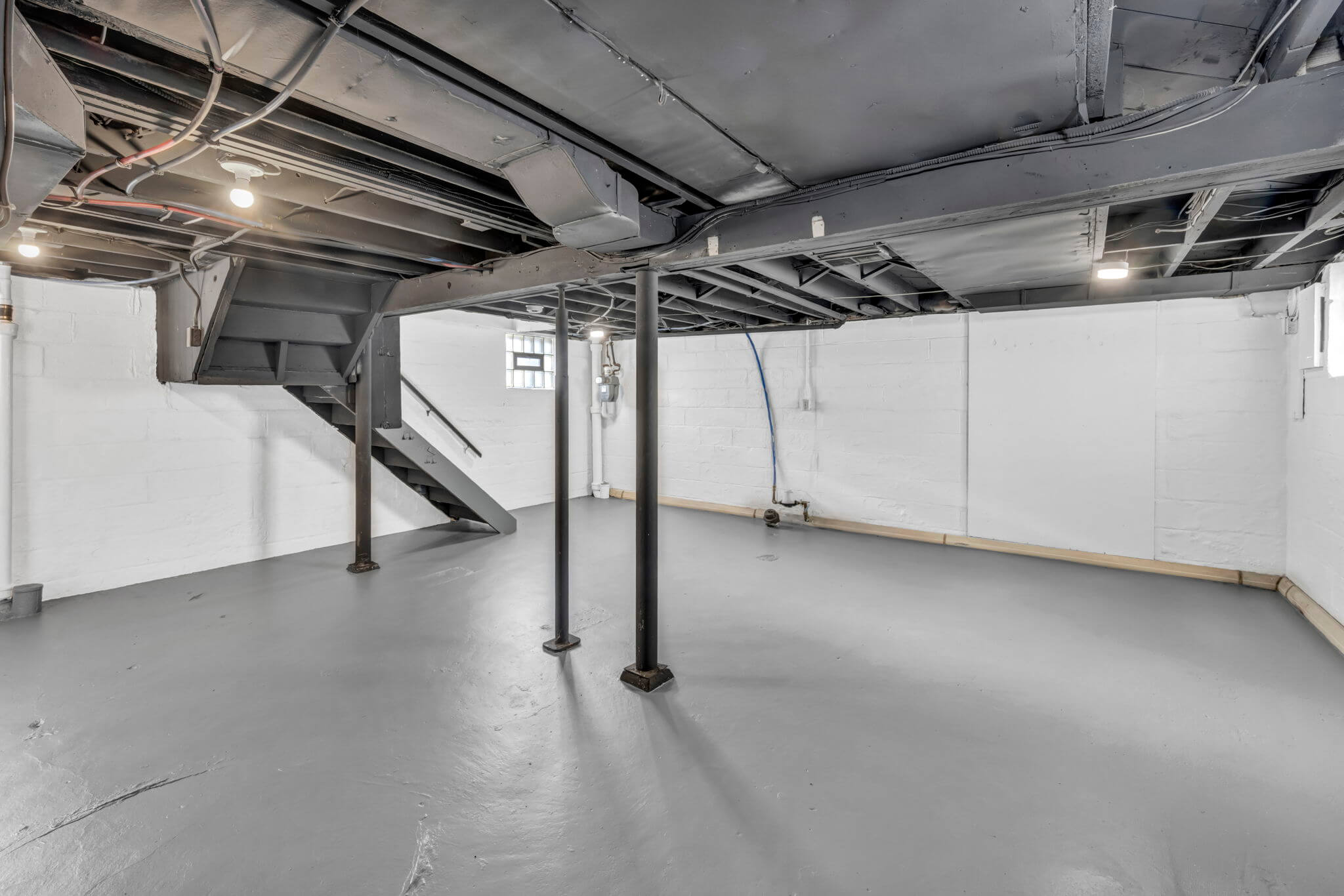
The Best Renovation Money You Can Spend on a Rental Is Paint. The Second-Best Is a Dry Basement You’re Not Embarrassed By.
Ask any landlord who’s actually turned a unit what gives back the most for the least, and you’ll hear the same answer: paint. A few hundred dollars and a weekend can make a tired unit feel cared-for, reset what you can charge in rent, and shrink the days a place sits empty. Nothing else in renovation comes close on a dollar-for-dollar basis.
What fewer landlords realize is that the second-highest-return paint job in the building isn’t upstairs. It’s in the basement — and the reason it pays off twice has almost nothing to do with the paint.
Why paint leads every ROI list
Paint is cheap per square foot and it changes how a person feels the moment they walk in. A prospective tenant doesn’t price out drywall or read your maintenance log — they read the room. Clean, even, recently-painted walls say “someone takes care of this place,” and that single impression lets you list at the top of your range instead of the middle. It’s the closest thing to free money in this business, which is exactly why it tops every renovation-ROI list ever written.
The basement is bonus square footage — if it doesn’t feel like a basement
Tenants quietly value a basement they’re willing to use. Storage, laundry, a spot for the deep freezer, a place to put the weight bench — a clean, dry, well-lit basement reads as extra living space they didn’t have to pay extra for. A damp, dingy one reads as a liability they’ll try not to think about. The gap between those two is mostly paint and a couple hundred dollars.
But here’s the catch, and it’s the whole point of this post: you cannot paint your way to a good basement.
You can’t paint a wet basement — and that’s the tell
Paint on damp masonry bubbles, flakes, and grows things within a season. So a basement that still looks clean and dry a year after you painted it isn’t a paint achievement — it’s proof the basement is genuinely dry. And a dry basement is never an accident. It’s the visible receipt for invisible work you did somewhere else entirely.
This is where we do it backwards from a flipper. A quick-flip operator paints the basement to hide the damp before a showing. We make the basement dry first, then paint — because we’re going to keep the property, and the seam always shows on the ones who skipped the order.
What “dry” actually requires (this is the part you fix first)
A basement that stays dry on its own — no dehumidifier babysitting, no annual repaint — almost always comes down to three things being right, and all three are about water that never reaches the inside in the first place:
- The ground slopes away from the house. Grading that pitches toward the foundation funnels every rainstorm straight into the basement wall. Re-grading the first few feet around the perimeter so water runs away is unglamorous and decisive.
- The gutters and downspouts carry water off, not down. Downspouts that dump at the foundation are doing the opposite of their job. Extensions that move the discharge several feet out solve a shocking number of “mystery” wet basements.
- The sewer line and lateral are actually functioning. In older Akron housing stock, a sluggish or partially collapsed lateral shows up as water where it shouldn’t be. A dry basement quietly confirms the line underneath it is doing its job — which is why we check it early, before anyone reaches for a paintbrush.
Get those right and the basement stays dry by itself. The paint is the last five percent — the part everyone sees, sitting on top of the ninety-five percent nobody does.
The black-ceiling trick that ties it all together
Once it’s dry, here’s the finish we put on nearly every property we keep: a clean gray floor, and the ceiling — joists, ductwork, wiring, pipes and all — painted flat black. It costs almost nothing and it does something a drop ceiling can’t. The black erases the mechanical clutter; the eye stops cataloguing every duct and wire and just reads “finished.” The room feels taller, cleaner, and intentional. Do it across a whole portfolio and every basement looks like it belongs to the same careful owner — because it does.
The order that actually pays (a landlord’s punch list)
If you take one thing from this, take the sequence. Doing it in this order is the difference between a basement you fix once and one you repaint every spring:
- Grade and drainage. Slope the ground away; extend the downspouts.
- Check the sewer line / lateral. Scope it if the house is old or the history is unknown.
- Dry it out and confirm. Let it prove it stays dry through a real rain before you spend a dollar on finishes.
- Paint the floor. A sealed gray floor is easy to clean and instantly lifts the room.
- Black out the ceiling. Cheapest “wow” in the building.
- Then go paint upstairs. Your highest-ROI dollar, spent last, on top of work that’ll hold.
-
Why we do it this way
We’re a local, family-owned team that buys houses for cash across Summit County — and we don’t flip and we don’t wholesale. We’ve bought 60+ properties here and kept every one. When you keep what you buy, you can’t afford to paint over a problem; it just becomes your problem next year. So we fix systems first and finishes last, and a clean, dry, black-ceilinged basement is simply what that discipline looks like once the drywall dust settles. It’s not a gimmick. It’s the receipt.
If you’re a landlord weighing whether to keep renovating a tired portfolio or hand it to someone who’ll do the unglamorous work properly, that’s a conversation we have all the time. You can read more about how we actually renovate the houses we buy, or if you’d rather just talk it through, call or text us at (330) 661-9885. We respond within one business day.
Every house is its own puzzle — grading, gutters, and sewer lines all behave differently, and a quick look from someone who knows older homes beats any blog post. But the principle holds everywhere: dry first, paint last, and let the basement tell the truth about the rest of the house.