
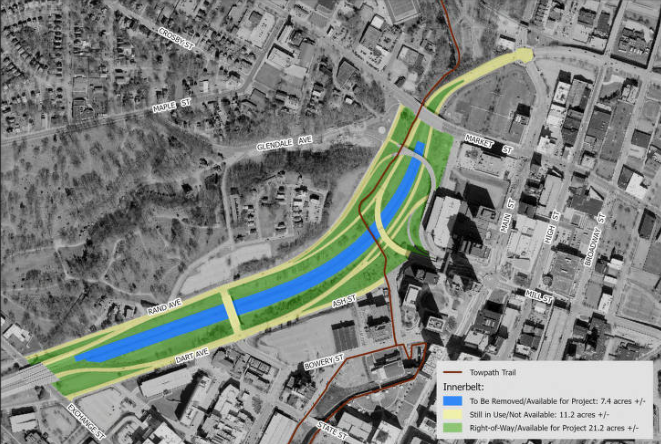
Something significant just happened in Akron — and if you own property in or near the neighborhoods touched by the old Innerbelt, you'll want to understand what it means.
The City of Akron has officially released its final Innerbelt Master Plan, a community-driven framework for reconnecting the neighborhoods that were cut apart when the highway was built decades ago. The plan includes more than 30 projects, $500,000 already budgeted in the city's 2026 Capital Budget to begin implementation, and a clear roadmap for new housing, infrastructure improvements, and long-term investment across the corridor.
This isn't a proposal. It's a plan — with money behind it, council adoption in process, and work starting this year.
What the Innerbelt Did to Akron's Neighborhoods
To understand why this matters, it helps to understand the history. When the Innerbelt was constructed, it cut through some of Akron's most established Black neighborhoods, displacing hundreds of families and businesses. The highway severed street connections, isolated communities from each other, and left a trail of vacant land and disinvestment that has persisted for generations.
For years, the decommissioned stretch of the Innerbelt has sat as a reminder of that damage — underused, disconnected, and a barrier to the neighborhoods on either side.
The new master plan is a direct response to that history. As Terrence Shelton, co-president of the Akron Rites of Passage Institute, put it: the goal is to restore what was taken — community identity, economic opportunity, and the ability to build generational wealth.
What's Actually Happening in 2026
The city isn't waiting. In 2026, implementation focuses on several near-term actions: updating zoning in the Innerbelt area to align with the plan's vision, beautification of the decommissioned highway portion, facilitating infill housing development on vacant land in the corridor, and resurfacing Vernon Odom Boulevard.
That last point — infill housing — is the one property owners near this corridor should pay close attention to. The city is actively working to bring new residential development into areas that have been neglected for decades. That changes the supply picture, the investment picture, and ultimately the value picture for everything around it.
Meanwhile, in Highland Square, the city just stood up a Special Improvement District — a defined area where property owners fund extra services like beautification, security, and maintenance. It's the same model that has driven Downtown Akron's revitalization. When neighborhoods get SID-level attention and investment, they tend to move quickly.
And in Sherbondy Hill, the Legacy Building Project is moving into its first phase — a proof-of-concept cultural center connected to Mt. Olive Baptist Church, with educational programs launching this summer. The larger $11.5 million African American Cultural Center and Museum Complex is planned for construction in 2027, located near Rhodes Avenue. This is generational infrastructure, and it's coming.
What This Means If You Own Property Near These Corridors
Neighborhood investment moves in cycles, and the early part of the cycle — when momentum is building but prices haven't fully adjusted — is where the most significant decisions get made.
If you own a property near the Innerbelt corridor, in Sherbondy Hill, near Highland Square, or in any of the surrounding neighborhoods, a few things are worth thinking about.
First, the city's investment in infrastructure, zoning reform, and new housing signals that these areas are being prioritized. That kind of sustained public investment tends to lift nearby property values over time — but it also means renovation costs and buyer competition tend to rise with it.
Second, the timing of a sale matters in ways that aren't always obvious from the outside. If you've been holding a property that needs work — whether you inherited it, have been renting it, or have been waiting for the right moment — the window where a buyer will take on a distressed property at a fair price without requiring you to invest first is open now. It narrows as neighborhoods improve.
Third, not every property owner in a revitalizing area wants to stay. We talk to homeowners and landlords regularly who have been in these neighborhoods for decades, who care about what happens to the block, but who are ready to exit. A cash sale to a local buyer who will renovate and hold — rather than flip or neglect — is often the best outcome for everyone involved.
Why We're Paying Attention to This
We're local. We buy, renovate, and hold properties across Summit County — and we've been doing it long enough to know that neighborhood momentum is real and that it rewards people who pay attention to it early.
We're not out-of-state money. We're not wholesalers passing paper. Every property we've ever purchased, we still own, and we manage them ourselves. When we renovate a house in a neighborhood like this, we're making a bet on that block — the same bet the city is now making with public dollars.
If you own property near the Innerbelt corridor, in Sherbondy Hill, Kenmore, West Hill, or Highland Square, and you're thinking about what to do next — we're worth a conversation. No pressure, no obligation, and no realtor fees. Just a straightforward discussion about what the property is worth and what a sale would look like on your terms.
You can read the full Innerbelt Master Plan at akroninnerbelt.com. The Signal Akron team has also been covering the Legacy Building Project and the cultural center in depth — it's worth reading if you want the full community context behind these changes.